November 6, 2025
Tour of the Universe: You are Here



Class Description
Rocket through space and sail among billions of stars and galaxies, all in the comfort of the EmpowerU studios.! Utilizing some amazing simulation software, one of America’s most renowned lecturers on astronomy will guide you through the mind-boggling scale of the universe.
Along the way you’ll stop at the Moon and individual planets. Then you’ll make the jump to light speed and head to interstellar space to see all the galaxies in the universe. We are very fortunate to have landed Dean Regas to give this presentation.
Dean has published books on astronomy, authored many articles in national publications, hosted a PBS program and led the Cincinnati Observatory for many years. Rocket through space and sail among billions of stars and galaxies. Utilizing some amazing simulation software, Dean Regas will guide you through the mind-boggling scale of the universe.
Curt Hartman has regularly taught EmpowerU students the importance of Ohio’s Sunshine laws, which allow citizens the right to public records and protect access to open meetings. The ability of Citizens to request records from their Governments is fundamental to helping people understand what their elected officials are doing.
Ohio Sunshine laws are currently under attack from Ohio’s Legislature, with many changes being made to the law which make it harder to request information. Curt will update us on changes in the Open Records and Open Meetings Act. and explain our rights in Ohio. Changes to the Sunshine Laws will make Ohio’s vast array of governments less transparent and less accessible than they have been in the past.
Speaker Bio
Dean Regas is a renowned public speaker, author, educator, national popularizer of astronomy and an expert in observational astronomy.
He served as the astronomer for the Cincinnati Observatory from 2000-2023 and was the Astronomer in Residence at the Grand Canyon in 2021. He is the author of six books including 100 Things to See in the Night Sky and How to Teach Grown-Ups About Pluto. From 2010-2019 Dean was the co-host of the PBS program Star Gazers.
Dean has contributed to Astronomy Magazine, Sky and Telescope Magazine, Farmer’s Almanac, USA Today, Science Friday and Here & Now. He is also the host of a popular astronomy podcast called Looking Up with Dean Regas.
Dean brings the complicated field of astronomy down to earth for people of all ages.
Curt Hartman is an attorney with Finney Law Firm in Cincinnati, OH, where he concentrates on commercial and constitutional litigation, as well as public interest litigation relating to the oversight at all levels of governmental operations. He holds a J.D. from Vanderbilt Law School, an M.A. from Georgetown University, and a B.S. from United States Naval Academy.
Tour of the Universe with Dean Regas
Audience Member: [00:00:00] Speaking of Dean. Yeah, we’re really, uh, fortunate to have Dean tonight, uh, with us. Uh, he’s, uh, very much in demand. It’s a busy schedule. Uh, in fact we wanna try to get him last semester, but so we, we got him this semester and that’s great. Uh, obviously he’s gonna give us a tour of the universe. Uh, he’s a renowned public speaker, author, educator, uh, a national popularizer of astronomy, and he’s an expert in observational astronomy as well.
So I guess that means he knows math, I think pretty sure. Uh, he served as the astronomer at the Cincinnati Observatory in Mount Lookout for over 20 years. Um, ended that in 2023. Um, he is, he was the astronomer in residence. Chose, selected to be the astronomer in residence, residence at the Grand Canyon in 2021.
The author of six books. Um, a hundred things to see in the Night Sky. How to Teach Grownups about Pluto are two of the titles, [00:01:00] uh, and from 2010 to 2019. Deans Dean was the co-host of a nationally, uh, televised program on PBS, uh, entitled Stargazers. Uh, he’s contributed to Astronomy Magazine, sky and Telescope Magazine, farmers Almanac, USA Today, science Friday and here and now.
He’s also the host of a popular astronomy podcast, which I’d recommend you tune into, called Looking Up with Dean Rigas. And he just brings a co the complicated field of astronomy down to earth for people of all ages. And he’s gonna do that tonight for us. Thank you, Dean.
Dean Regas: Thank you. Uh, thank you Tom. And, uh, good evening everybody. And, uh, uh, it is, I think, appropriate that Tom won the book, right? I mean, Tom’s the one that got me here, so that was not fixed. Hopefully there’s no public record we can look at, uh, [00:02:00] about that. But anyway, um, it’s my great honor to be here, uh, to talk to you about, uh, the entire universe.
Uh, and, uh, so I’ve been doing astronomy for more than 25 years. I got my start working for the Cincinnati Parks at, uh, Burnett Woods, the Trailside Nature Center. There was a little planetarium there, and I got to, that’s where I learned astronomy first and just fell in love with the subject. And so I’ve been kind of starstruck ever since then.
And, uh, uh, it, it, uh, you in any time, it just seems like, uh, doing stargazing is my. Uh, form of therapy. It’s my way to get out under the stars, see things relax a little bit. And, uh, my, uh, great aspirations are to see total eclipses and super moons. Did anybody see the moon last night? I like to keep things simple in my life.
And so this is what I do is to, to, uh, to see around and see what’s up in the sky. And so today we’re gonna think [00:03:00] really big. We’re gonna go out to the edge of the universe and back and show you what is out there. Um, and so, uh, uh, like Tom said in the introduction, uh, maybe some of you have seen me, uh, on tv.
I was on the co I was co-host of the Stargazers TV show. This is on PBS. And if, uh, it was me and my buddy James Albury, we came to you every single night for about nine years and was on at a very convenient 1:00 AM. So if you didn’t see it, I’m not too hurt. Uh, but anyway, that’s where they usually aired it.
And so we would, uh, fly around the space to tell you what’s going on in the, the universe. Uh, so now I do a podcast called Looking Up. Uh, so wherever you get your podcast, check that out. It’s through, uh, conjunction with Cincinnati Public Radio and WVXU. And so I interview, uh, guests from around the astronomy world.
We have new episodes about every two weeks, so check that out wherever you get your podcast. And I’m the [00:04:00] author of seven books, including a hundred Things to See in the Night Sky, thousand Facts About Space. I have a new book called All About Orion, which is a tactile astronomy book. This is a, uh, combination braille and, uh, uh, tactile astronomy so you can actually feel the outlines of the constellations.
And so this is done, uh, with, in conjunction with our local printer, Clover Nook, center for the Blind and Visually Impaired. So they’re the ones, this is their first, uh, unique, uh, uh, published book. And so it’s a great honor to be working with them on that. Uh, and then my controversial How to Teach Grownups about Pluto is out there as well.
And so, uh, I need to test my audience here. Uh, how many of you all are still mad about what we did to Pluto? It’s a few. Hands up, a few hands up. All right. Uh, so, uh, by and large I’ve, I’ve found over the years that [00:05:00] the majority of kids don’t care, but that the majority of adults do care for some reason, and I don’t know how many times this has happened where I’d give a talk about astronomy.
Any different topic could be the tour of the universe could be a hundred things. See a night sky, kids would come up and ask questions and then also like talk about, Hey, did you hear about this new discovery? And I’m like, yeah, yeah. Did you hear about this? And then in the back you see them striding towards you with a purpose.
An adult scum up and they might even come up and shove a kid outta the way, all to tell me Pluto’s still a planet. And then they walk back away. They might even shove a kid on the way out. And I was like, whoa, this is intense. People have feelings for this little thing. And then I felt bad for the kids, so I thought I need to write a book for the kids [00:06:00] to help their traumatized adults.
So it’s a, uh, kid’s book, but really sneaky for the adults. And it is, uh, illustrated, including the five stages of grief. Never seen a kid’s book with that. I, I had to lobby to get that one in there. So, as you can see, I have a little fun with the subject ’cause astronomy is a fun subject. Astronomy is, uh, a big subject.
It’s, it’s all encompassing and we’re learning so many new things every day that it’s just a dynamic subject to go in. So I’ll have, the books are up here at the front, uh, at the end. You come on up, browse, check ’em out, and I can sell ’em, sign ’em, all that kind of stuff. And it’s holiday season, right? Come on up.
I mean, you got the author here, so come on up and we’ll check out the books at the end. Uh, but we’re gonna go a little bit farther and Oh yeah, that’s right. And Tom mentioned this, I was at the, uh, the Grand Canyon. I was their astronomer in residence and so this was my view basically out my [00:07:00] window every morning.
So I got to live and work at the Canyon. It was one of the most remarkable experiences in my life. Uh, and I even got to do astronomy down at the bottom of the canyon where they have a telescope already, so I didn’t have to carry it. That’s good. Um, and then I was just recently out there for two weeks, uh, doing programs with them.
So I get to go back out there quite often. Such a great amazing park, such a dark sky park where you could see the Milky Way straight overhead. Uh, it’s just amazing place. So, uh, highly encourage people to get out to dark skies and national parks and, and see these things ’cause it’s just incredible. So we wanna get out a little bit farther and, uh, we’re gonna be taking a tour of the universe.
And so, uh, first little bit we have to get through is, what is the universe? Anybody like to tell me short? I like short definitions, everything. Correct? One word. I like that. The universe is [00:08:00] everything. So all the gases, all the stars, all the galaxies, everything out there. Now this is a good idea. This is a good kind of intro.
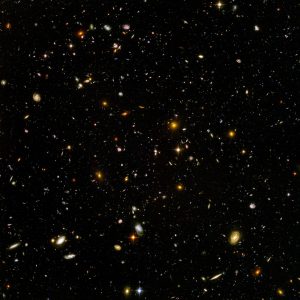
This, this image here that I had earlier. This is, uh, an image taken by the Hubble Space Telescope. And this will kind of, hopefully get us in the mood for my theme. Uh, which should I tell you what the theme is already? Okay. Uh, space is really big. That’ll be reoccurring over and over again. Um, so this is a picture taken by a Hubble Space telescope.
The idea from this picture is they wanted, uh, they looked at their star charts, they saw a blank area. This is an area about the size of a postage stamp, about a hundred feet away. That’s how small of an area we’re looking at. And on the map, they had nothing. So they’re like, well, we got this new telescope, let’s point this at nothing.
And that’s what came back. [00:09:00] Each one of those dots is not a star. Each one is a galaxy. And a galaxy is a conglomeration of billions and billions of stars. And so in this one picture where they had nothing before, they found 5,000 galaxies. All right, what was my theme again? All right. Okay. Starting again.
Space really big. So this is just our little bit, this is a teeny tiny section of the entire thing. So I’m going to, uh, switch to a program that can simulate everything. It is our map of the entire universe. And so I think, uh, I know it’s getting late, but, uh, can we dim the lights please? You guys be okay if I turn the lights on?
I used to be a school teacher, so I can come, I can come where you are. I can kick chairs in case I see somebody sleeping. Plus I have good eyesight in the dark, so I can see you guys. Uh, let’s see. We’ll go a little darker here. There, uh, there it is. [00:10:00] All right. Everybody see the screen? Okay. Everybody at home see the screen?
Okay. How many people we have viewing from at home, just outta curiosity. Hi. Hi everybody. All right. We’re gonna go really far out in space here. Now the way that this works is, uh, there’s the earth, there’s the rest of the universe, and we can fly up and go anywhere we want. We’re gonna leave the earth behind, blast off and rock it and go up above the planet.
And so here we go, and we can turn around and see the entire planet. And we started in Japan because it’s a Japanese program, so. So I could click and drag and we can look at other parts of the globe. So we have Asia over there, and Europe there and Africa. There we could see where the daytime side is and the nighttime side is.
So this is supposed to be tonight where the, we’re in darkness over here. And when we’re facing away from the sun, it’s [00:11:00] nighttime. When we’re facing towards the sun, it’s daytime. And so, uh, this is our place in the universe. This little ball, about 8,000 miles across. Now, I can also move our time forward so we can go backwards and forwards in time, and so we can make the earth rotate.
So this is what we do every single day, spinning around in Cincinnati. We’re moving about 800 miles an hour or so every day. So we’re, we’re kind of moving around. So if anybody says you’re not doing anything. No, I’m moving pretty fast, so, so there’s our day and our night. Now let’s leave the earth behind and now we’re gonna go out to our next level.
So we’re gonna make some stops along the way. And so what’s gonna be our closest thing to the earth? The moon. All right, I like that answer. And there is the moon. So there, look how tiny the earth is. The moon is that little speck right there. And that’s the distance between the two of us. [00:12:00] Surprising, right?
I thought we were a lot closer than that. This is the scale model. So this is 240,000 miles, the average distance from the earth to the moon. A three day rocket journey for Neil Armstrong and Buzz Aldrin. So they get in a rocket three days to get to the moon, a couple days on the moon, three days to get back.
So I always like to ask my audience, how many of you would. Do that free round trip? Nope. You gotta come back. Sorry. Unless something goes wrong. You know, if you sabotage it, then you’re not coming back. So, yeah, that, so this is what we’re looking at for future missions. It’s gonna be a little bit longer.
They’re probably gonna be 10, 12 days to go to the moon and back. Uh, but that’s, that’s about the journey. Now the moon is going around us. This is the moon’s orbit, and so we can get our time going a little bit faster and watch the [00:13:00] moon go around the earth. There we go. So it takes about one month for the moon to go around the earth all the while the earth is spinning pretty fast in there.
There we go. So we’re racing into the future. We’re already in 2026. Keep an eye on that. That’s the other plus is astronomers know where everything’s gonna be. So let’s leave the earth and moon behind and then we will make our next stop. As we open up our scale here, we can start to see the Earth’s pathway around the sun and we see another planet’s orbit there.
Anybody want to guess what that one is? Venus There? Very good. That one Mars there, that one Mercury there. There’s the sun right there. So let’s put the sun in the center. And now we have our four inner planets, mercury, Venus, earth and Mars. And let’s see them going around the sun. Here they go and they go around the sun like that.[00:14:00]
So they all go around the sun the same direction. That’s interesting. They don’t go the same speed. Who’s fastest? Mercury. Who’s second fastest Venus? Who’s third fastest Earth and who’s fourth fastest Mars? Wait a second. That sounds like a pattern. That is the pattern closer. You’re the sun, the faster you go.
Mercury takes 88 days to go around the sun. Earth takes 365 1 year. That’s right. So every time you celebrate a birthday, it’s another trip around the sun. And usually when I go talk to a school group, I say, uh, yeah, you’ve been around the sun 10 times. They’re like, oh, cool. And I say, your teacher’s been around the sun about 95 times.
And the kids, you know what they do? They’re like, yeah, that’s about right. That’s about right.[00:15:00]
So now, uh, there’s also another object on here called Raku. Raku is an asteroid, a near earth asteroid, one of the many that come nearby the earth. And the reason why it’s singled out. It was visited by a Japanese spacecraft, Japanese program. By the way, this program is free, downloadable from the internet.
Uh, it’s called metca. See me afterwards. I can give you all the info, but it, you can get this at your house and do this yourself too. It’s pretty cool. So, uh, there’s also one red circle here. This is a distance marker. This is one au, uh, which is short for astronomical unit. Uh, that’s the average distance from the earth to the sun, about 93 million miles.
So that’s our distance to the sun. 93 million miles or one au. Okay. So if we’re gonna go visit a planet with people, mercury, Venus, or Mars, who votes for Mercury? [00:16:00] Who votes for Venus? Who votes for Mars? Okay.
How come? How come Mars is the one? Why isn’t it Mercury? Well, mercury is too close to the sun. Radiation of the sun will kill you in route. Bad Venus is not great because of the heat and the pressure. It’s 900 degrees on the planet all the time, every day, all day, and the air pressure is 93 times that of Earth means you will be squished and then melted.
So Mars is our only shot because that’s the only one where we at least won’t die instantly. We got a chance, at least at Mars. That’s what we’re now the only thing is how far is it? If you wanted to fly from there to there, remember it’s only three days to go to the moon and we had some volunteers to go to.
Mars is a seven month, one way trip, [00:17:00] seven months to go from there to there. By the time you get there, you can’t turn around and come home. Because Earth is over here, so you have to wait one year on Mars for the Earth to catch up and then fly seven months back home. So round trip is 26 months. Alright, so who wants to volunteer for that?
It’s free. No, I’m not allowed of takers for that one. S so, well, let’s keep backing up here Between Mars and Jupiter, this is this region filled with rocky and metallic objects that are circling around the sun. This is the asteroids in the asteroid belt. And, uh, this is one of the newest fields because we are discovering the asteroids every day.
Uh, we’re now up to about 1.3 million asteroids that have been discovered all going [00:18:00] around the sun. All different. And the reason why we’re finding them is because we’re looking for ’em. ’cause we’re looking for ones that are coming at us and hopefully can save us from being hit. And so I got good news.
None of those 1.3 million asteroids are gonna hit the earth. Does that make you feel good? Okay. What about the ones we haven’t seen yet? No, just keeping you on your toes. That’s all. Just, that’s why we’re keeping looking. We wanna see them as much as possible. Now, um, we’ve been looking at this from the top, but space is in three dimensions, so let’s go sideways and we’ll see.
The solar system is very flat. All the planets are in the same disc, the same kind of lineup. Some of the asteroids are offline a little bit. This is an asteroid called series that orbit right there. And there’s only one really diagonal line going through here. And did you see which one that one was?[00:19:00]
Where is it? It’s down there somewhere. It is? Oh yeah, Pluto. Sure. Yeah. Let’s just keep that a planet. Yeah, why not? All right. Well anyway, we’ll get to Pluto soon enough. Uh, so, uh, backing up some more, we get to the planet, Jupiter and then Saturn. So Saturn is one that’s about 10 times farther away from the earth than, than the, from the sun, than the Earth is.
And let’s just zoom in on Saturn ’cause it’s just too cool. So Saturn has 274 known moons now, also kind of new Titan is the biggest one, but of course, Saturn’s most known for the gorgeous rings that are around the planet. This gives it that view that just looks unreal and a telescope. And the rings are very wide from one side to the other, but extremely skinny.
And so right now, uh, the rings are very skinny, so it looks about like that in a [00:20:00] telescope. Uh, so they’re slowly, but surely will open up over the next few years. But Saturn is one of those planets that you can’t, uh, it just, uh, mind blowing when you see. And right now is good Saturn season. So if you have a telescope, it’s a good time to look for it.
Okay, let’s keep backing up. And now we get out to the planet’s, Uranus and Neptune. So Neptune is our farthest of the planets, uh, and they all going around the sun too. And here we have Pluto. Now let’s get them moving here. We’re gonna go around, uh, we have to go one year at a time now to show them moving at this distance.
Uh, so it takes, uh, Pluto about 248 years to go around the sun. Once there it goes. Okay. So why isn’t Pluto a planet anymore? Well, it’s not because it’s small. It is about the distance from [00:21:00] Cincinnati to Denver. That’s how big it is. Uh, it’s not because it’s orbit is weird that it goes out farther and in here.
And in fact, it’s closer to the sun than Neptune for about 20 years. And I don’t know about you all. I was in school between 1979 and 1999, and my teacher never told me that Pluto was closer to the Sun than Neptune. Did your teacher ever tell you that? I can’t believe that. Well, if you weren’t in school then, sorry, that’s, uh, then they told you, right?
So it’s not that. It’s not because Pluto’s orbit is different and tilted compared to all the other ones. It’s not because Pluto’s made of Ices and none of the other ones are. The reason why Pluto’s not a planet is because they found more stuff. So when we were kids, it was the only one we knew about out here that went around the sun.
But our technology got better and we found things like Hal, Maya, MKI, [00:22:00] MKI, Aris, and maybe you could just barely detect all these other little dots that are right here that are also going around the sun. You see those little things that are just barely making ’em out. So astronomers found those by the thousands in the last 25 years.
And so the astronomers had to get together and figure out, okay, Pluto’s still planet, what are we gonna do with the thousands of other things we just found? And you know what some of them said? Make ’em all planets. Make ’em all planets. Make ’em all planets. And what’d the kindergarten teacher say? How am I gonna teach the kindergartners at 2000 planets?
It doesn’t, didn’t make sense to include all of those things because they’re different. They’re different origins, different compositions, different orbits, and Pluto is one of them. And so [00:23:00] that’s why Pluto got kicked out. They didn’t do it real good and they didn’t write up a real good definition, but that’s what they did.
And I was still mad at first ’cause I thought, well this, you know, I don’t know about this. Um, Pluto was my favorite because it was kind of the weirdest one. But then I learned of a new weirder one. It turned out Pluto wasn’t so weird. It had thousands of other relatives. But then there’s this thing called Sedna, which nobody talks about.
It’s almost as big as Pluto. Its orbit goes out a thousand times farther away than we are, and it moves. We have to go a hundred years at a time just to see it moving. So it goes slow when it’s far away. Fast. When it’s close. Takes over 10,000 years to go around the sun once. That’s weird. So anybody that’s mad about Pluto here is your new object.[00:24:00]
Embrace the weirdness of cna. Well, I know that probably didn’t help much either, but let’s keep backing it up because past here, this is where we get into a region called the ORT cloud. This is where comets live, long period comets that are circling around the sun. And so we see these comets come by from time to time.
We have a couple comets in the sky at night right now. They’re very faint, but they came from out here. And then some comets go out as far as one light year. That’s the distance. Light travels in a year or about 6 trillion miles from there to there. So anything coming into the circle, basically the sun is going to affect.
Okay, so that’s our solar system, and the sun is in the center. Well, let’s check out the sun. This is holding everything in here. Everything I’ve showed you so far goes around the sun. So if we want to go to the next level, [00:25:00] we gotta go to the next sun or the next star. You see some in the background, look familiar, make a little shape up there in the upper right, that’s the big dipper right there.
Look that each one of these is star. Our stars. Each one of these are bigger than our sun and they’re not. It’s not even close how much bigger these are than the sun. And so if we wanna go amongst the stars, we have to go way out again and we have to go past that one light year mark. And notice, even if you’re out here at Pluto, the Big Dipper still looks like the big Dipper.
You’re not far enough away to change the view of the stars. We’ll only start to get changing once we get out. Light years away, starting to get a little weirder, but still pretty normal. And so here we are at the nearest star to us called Alpha Centara, right here. And it’s really a three star system, three suns that are [00:26:00] circling around each other.
So if you live there, you’d have three stars in your sky. And yeah, three suns, two yellow ones, and one little red one. So imagine watching one sun set. You think it’ll be dark? Nope. Another sun comes up on the other side. And so, well, I can tell you how far away it is, but I think the best way is How long would it take you to get there?
So three days to go to the moon, seven months to go to Mars, nine years to go to Pluto, to go to Alpha Sari with the fastest spaceship we’ve ever made will take you a mere 74,000 years. Yes. And usually when I show that to kids, there’s a kid in the audience that yells out I’d be dead. Yep, yep. You’d be dead.
That’s right. That’s correct. So that’s the closest star to us. These other [00:27:00] stars are much farther away. The Big Dipper stars are about 80 light years away. And look, now that we’re out amongst the stars, we see some of the other farther ones like Cap Pollocks and Castor Capella, all Deon. There’s our North Star up here, Polaris.
And here we are over a hundred light years away and we gotta think in three dimensions too. So these stars are all around us.
We’ll keep on going. And here’s some other fainter farther away stars like Beetlejuice and Rigel Deni. And so these are some of the farthest stars you can see with the naked eye. Okay, well let’s take a little pause here for a second. How’s everybody doing? Everybody? How’s everybody feeling? You feeling big?
Mighty important? Ah, well, I like to take a little breath here because if you’re [00:28:00] feeling small, if you’re feeling insignificant, it’s gonna get worse and it’s gonna get worse real fast because these as all of the stars that you’re seeing at night. So you go outside, some of those are the stars you see out there.
These are really gigantic stars. Um. They are only a teeny tiny, itty bitty section of one spiral arm of our galaxy. And so there is our Milky Way galaxy that we live in. It’s about 300 billion stars all circling around a center of mass. Looks like a big pinwheel. And the sun is that one. 300 billion suns.
And we’re there. Ah, we’re not even in the center. We’re not even [00:29:00] downtown. Well, what is in the center? That’s where most of the stars are jam packed. So it’s hard to form planets in that area. Region, ’cause stars are so close to each other. But if we go right into the heart of it. We’ll find a deep, dark, mysterious object of incredible density.
Anything that falls into it disappears. Not even light can escape and it warps the space and time around it. It is the black hole at the center of the galaxy. So what’s amazing is that we had this artist rendering and then a few years later got a picture of it. Looked just like that. So what is this?
This is an object. Uh, if you smash 4 million suns together, uh, the gravity is so intense, light doesn’t escape. So what goes in doesn’t come out. What’s going on in [00:30:00] there? Nobody knows. A lot of speculation, a lot of science fiction written about it, but nobody knows what happens. I just recommend don’t fall in.
So now luckily this is very far away from us. It’s never going to hit the earth. It’s never gonna swallow up the sun. It is so far away that we are can watch it from a great distance, a safe distance. Well, let’s get back out here. And woo got bright there. And so we have little galaxies that are around us.
Some of them circle around us, some of ’em are just passing through. And if you’ve ever been to the southern hemisphere, there’s two dwarf galaxies that you can see with the naked eye. They’re called small madu cloud and large Madu cloud. We can’t see them from our latitude, but other dwarf galaxies around us also.
And our next [00:31:00] major galaxy out here is called the Andromeda Galaxy right there. And this has well upward of 1 trillion stars. Now, just to give you an example about this. This is, you know, hundreds of billions to 1 trillion stars are shining at you and they’re outside right now they’re up in the sky. I’m not sure which direction east is, but east that way east, you look up there, you won’t see it.
1 trillion stars and you don’t see it. That’s how far away that galaxy is. If you’re out at the Grand Canyon, you can just barely make it out with the naked eye. It’s incredible how far these galaxies are away. So, ’cause people say, well, how come we can’t see [00:32:00] like aliens? It’s like, well this is a trillion stars.
Take your son out there, multiply by a trillion and we could barely see it. We’re not gonna see like a little guy going like this. It’s not, it’s not gonna happen. So let’s get back to the Milky Way here if I can. It’s not letting me click on it. Well, I guess we’re stuck. We’re stuck on Andromeda, unfortunately.
Yeah, I guess we are stuck. It’s like the, there we go. Okay. All right. So, uh, we got one more big, big, big leap to make and that is to show you the whole universe. We started at the earth, we saw the moon, we saw the planets, we saw the stars, we saw the galaxy. Now we gotta show you the whole universe and, well, this can be a little unsettling.
Uh, is anybody having a sinking [00:33:00] suspicion about the dots that are in the background? Those dots aren’t stars. Those dots are all galaxies. Each one is a galaxy that we’ve seen, mapped, charted, and in most cases named, each one has billions, two hundreds of billions of stars in them. And so I wanna show you how many galaxies we’ve found so far.
So here we go. Backing it all the way up. Hold onto your seats.
And there we [00:34:00] are. The entire universe, all in one little dot woo. That’s hard to take, isn’t it?
Okay. You want the good news or the bad news? Good news first. Look at where you are in the center. Yes, we’re in the center. Isn’t that good? Well, yeah, that’s, uh, well, the problem is if the universe is everything, then it goes on forever, in every direction. And so wherever you are is the center. Wherever you go is the center there in the center also doesn’t help much does it.
This colorful stuff is not galaxies. This colorful stuff is the leftover heat from the creation of the whole universe, from the [00:35:00] Big Bang. It’s the farthest stuff. We can detect farthest energy. And so this is it Outside of this. I don’t know. Could be something. Could be another universe, could be nothing.
Could be it. We can’t fly to that part. We can’t see past that part because there is nothing there and never has been, and there’s no time there. All right. How late is it? You guys up for a deep thought. This is gonna be pretty deep. Okay. So there is a real reason why we can’t see past this, and it is not because it’s too far away.
Uh, whenever we look in [00:36:00] space, it, we’re looking back in time. So it takes time for light to go from one place to the other. Uh, the sunlight takes eight minutes to get from the sun to your eyes. So when you look at the sun, that’s how the sun was eight minutes ago. When you look at stars, that’s where they were years ago.
The light’s taken years to get to your eyes. We can’t see past this because this is before time. There was nothing because the universe wasn’t created yet.
Speaker 4: Yeah.
Dean Regas: Yep. Anyway, now, uh, this is the part where I also say anything that I can tell you about the entire universe makes no sense to me. When I wanna show you what Infinity looks like, and I show you this, [00:37:00] you’re like, well, that’s not infinity, right? Is there more? I don’t know. How did we get there? How could we see all the way to the edge of the universe?
And beginning of years at the same time? I don’t know. Where did this all come from? I don’t know.
And so my famous conversation that I have with, uh, cosmologists, these are people that study the entirety of the universe in the beginning and the end. Um, there’s this real, when I, when I finally realized they have no idea what they’re talking about, this is what happened. Because maybe some of you heard that the universe is expanding, that these galaxies are moving away from each other and the whole universe is expanding.
So my conversation with a cosmologist goes like this. I say, the universe is everything, right? And they say yes. And I [00:38:00] say, and the universe is expanding, right? And they say yes. And I was like, how can it already have been everything and infinite and still expanding? And they say, yes, we are not deities. We cannot understand infinity.
And so this is the best map that we can make of it. I know. So let’s pause for a second. Any questions come to mind while we’re at the edge of the universe here and looking at this deep thoughts, not so deep. Thoughts.
Oh. How cold is it? Well, um, so this, these colors here are indicating temperatures. This is called the cosmic microwave background radiation, and we’re looking at the fluctuations of a few degrees Celsius. So we’re talking almost absolute zero out [00:39:00] here. These are just slightly above absolute zero. That’s what we’re pick picking up here.
Yep. Yes, in the back. Oh, oh, sorry about that. Oh, I’ll repeat the question too. I can repeat the question.
Speaker 4: I was curious, do the, the, the scientists, can they estimate. When the big bang, if that’s what they’re saying when it occurred, like how many mil, billion years ago or whatever from this?
Dean Regas: Yeah. So the, uh, the estimate, the question is like, when is the estimate of when the big bang occurred? When did the, uh, the whole university created and the, the best, uh, ev the evidence is pointing to in multiple different directions from different directions to a age of about 13.8 billion years ago is when this happened.
So that’s why the edge of the universe, the farthest [00:40:00] things we could see are 13.8 billion light years away. So that is, that is the estimated age. Now, what kind of certainty do we have in that? I don’t know. These are smarter people than me that have figured this out. Um, but there’s lots of different lines of evidence that are pointing to that around that date
Audience Member: budget.
Dean Regas: Okay, go ahead.
Audience Member: Okay. So are, are you, uh, are you starting to take questions now or just a quick
Dean Regas: one? This is, yeah, these are the quick questions. I, these are quick, quick but
Audience Member: big
Dean Regas: questions.
Audience Member: Okay. So here, here’s a fun one. So, um. I don’t understand space time, but apparently it can be folded. And I, I’ve heard some speculation, even a little bit of science fiction about time travel.
If space is folded, can you,
Dean Regas: sure. Yeah. So can, can you travel through time? Can you travel through space faster than the speed of light, that kind of thing. Can you [00:41:00] fly through things at warp speed, like in Star Trek? Um, right now there’s, we have no way of being able to figure out how to do any of that. Uh, there is a, definitely the speed of light is a limit that we cannot break with our current technology.
Not even close. Because when you go faster and faster and faster, that object, basically, it takes more and more energy to move it. You become more massive as you’re traveling faster. So when you get to almost the speed of light, there’s not enough energy in the whole universe to move you over. So we can’t go faster from speed of light unless we can figure out how to break that law and, you know, maybe give us a couple million years, we might be able to figure that out.
One of the, the, the quicker ways that we’re thinking of is, well, let’s say space and time are all relative [00:42:00] because, well, that’s not really what the universe looks like. That’s just what it looks like from our perspective in the center. So what if you lived somewhere else? Your, your reality would be quite different.
Your map of the universe would be quite different. And so that’s what space and time is. It’s, you are in a different space at a different time. The universe will be different. So if you want to go across the universe, you take the space and you bend it. Then you take, you know, if you have your fingers this far apart, just bend space and bring the two fingers closer together, how much energy would that take?
A lot. And then you just go from one place to the other. So it’s kind of like the wormhole theory. Uh, and all of this is, you know, there’s no, it’s great science fiction. It’s, there’s no science fact to it that we [00:43:00] can figure out.
Audience Member: Here’s a question right here.
Dean Regas: Okay?
Audience Member: Yes. They talk about, uh, faster than light speed.
What about inflation that occurred after, uh, the big bang?
Dean Regas: Oh, I know. This is so faster than light. Faster than speed of light. Nothing go faster than the speed of light. But let’s say you have one star moving this way. Point six, the speed of light. And you have another star moving that way at 0.6, the speed of light.
Now they’re going away from each other faster than the speed of light. What happens then? If you’re by the one star and you look back at the other star, it’s gone. You will not see it. ’cause it’s going faster. Speed of light, the light’s not gonna catch, come to you. And so it will disappear. So could there be [00:44:00] things out there that have disappeared because they’ve gone faster?
That and as the universe is expanding, things are getting farther away. They’re moving farther away from us. Could they disappear? Yes. Will we ever know it? No. ’cause it’s gone. This is why this is the most frustrating field.
Audience Member: Here’s a question
Dean Regas: right to think about though. Okay. Go ahead.
Audience Member: Question right here.
So, uh, you’re saying we’re the center of the universe, so it the.
Dean Regas: No, I, I’m the center of the universe,
Audience Member: so
Dean Regas: No, you’re the center of the universe.
Audience Member: So that eight right there in 13.8, if we’re the point between the, say the two, the thir, the three and the eight, there’s a star. Let’s say we’re sitting right on it.
Dean Regas: Yeah.
Audience Member: And, uh, we look towards, away from our, our current where Earth is and out where the arrow is. Right there.
Dean Regas: Right.
Audience Member: Is there anything out there? [00:45:00]
Dean Regas: See, this is, you’re not gonna like this answer either. That’s the thing is I, I’m gonna give you terrible answers. Well, the problem with this map is that star isn’t there anymore.
That’s where that star was 13 billion years ago. Like that’s what it looks like to us. So we go to that star, it’s not there. It’s already been gone for 13 billion years in its own other direction. And so it’s all the way out here. And so you can’t say like, I’m gonna go there ’cause there’s not there. And if you could go there, then you’ll be in the center again and all the rest of it’ll just be around you and you’ll look back to where the sun was and you’ll be like, sun’s not there.
Uh, ’cause it wasn’t made yet. I know. This is, it doesn’t make any sense, does it? I’m at least admitting to you it doesn’t make any sense. [00:46:00] The other astronomers won’t. ’cause they think it does, but it doesn’t.
Audience Member: Here’s the question right here.
Dean Regas: Okay.
Speaker 3: That, that kinda leads into my question is if like a star is 10 light years away from where we are and that star dies, does that light still emit for 10 years?
Do we still see that light for 10 years?
Dean Regas: Yeah. So if a star is 10 light years away, it suddenly dies. We won’t know for 10 years until the light stops. And so that’s the, the most famous one. There’s a star out here called Beetlejuice that makes the news quite often because Beetlejuice is red, super giant.
It’s gonna explode into a supernova any day. And sometimes the, the media gets an astronomer to say, maybe it already did, and we don’t know. And uh, the reporter’s always like, whoa, that’s cool. I’m gonna write about that. Astronomer says, Beetlejuice already exploded. We don’t know. I’m like, uh, that, um, that’s not what they said, but okay.
Uh, and so yeah, we won’t know for [00:47:00] 600 years until the star explodes if it already exploded. Uh, so that means you could go outside and you could see it explode any day. And do we know when it will? No. When will we know when we see it? When’s that we don’t know. That doesn’t make a very good news story, so that’s why the reporters write it up differently, but that’s how I would write it.
So yeah,
Audience Member: Dean, Dean is, is the evidence that there was a big bang? Is it, is it simply that we’re expanding that they know, we know we’re expanding the universe?
Dean Regas: Uh, so yeah. Is it because we’re expanding? No, it’s mostly because of the stuff we’re detecting. This outside stuff is, was really the linchpin behind it.
That this, this, uh, non-uniform, uh, energy, uh, really goes to this model of this one moment that things moved away from it. There is a little, there is definitely that idea that almost every galaxy is moving [00:48:00] away from us. Uh, and so the only galaxy that’s headed towards us, that’s a major one is the Andromeda Galaxy.
That’s because we’re too close together. Um. Yeah, there’s lots of lines of evidence for this. Um, not exactly my field of expertise, so I can’t say much more than than what I said unfortunately. Okay, so it’s getting cold out here. Let’s fly you back home and we will get to the one question maybe you’re nervous about asking, but I’ll get to that in a second.
Let’s go target the earth and I’ll fly us back home really fast. Hold onto your seats here we go through the galaxies, through the Milky Way, through the stars, through the planets, and back to the earth and the moon. And quite a journey to the edge of the universe and [00:49:00] back. I got you home a little late. I was gonna talk for about 45 minutes, but it’s apparently November 29th, 46,184.
So I did go over just a little bit. Sorry about that guys. Earth’s still there though. That’s good now. Um, so. You know, why, why do I show you this program? Why, uh, I don’t know. Why do I think this is such a cool thing? I, I think number one, getting the perspective, this is something astronomers have, they have this different kind of universal perspective on things.
It makes us, uh, you know, because some people are like, well, it gets people depressed. And like, some people have asked like, how do I deal with this depression of this? And I’m like, well, it’s, I don’t know. It doesn’t bother me that, that we’re little, teeny tiny things. I kind of like it that we’re a little small things because I also think, well, we’re pretty small, but we’re pretty [00:50:00] smart.
I mean, we, we made a whole map of the whole universe that’s pretty good. And we’re adding to this map every single day. This is kind of our legacy is, uh, you know, humans, we’re explorers, we’re curious creatures. This is how we got to where we are being scientific people. And so, uh, this is just our, our.
Latest trying to make sense of the universe. And I love it. I get to learn something new every day. I’m like a big kid with this kind of stuff. I, I should say, little kid, some little thing. Um, so this is what I think it really kind of opens up your worldview a little bit. It it also kind of, you know, when you see these pictures taken by the NASA missions of the earth and it’s one pixel wide and it just makes you think like, you know, in the scheme of things, you know, I, let’s just appreciate our perch from right here [00:51:00] because this is it.
This is all we got. And I hate to tell you those ideas of us going somewhere else. That ain’t gonna happen. We’re gonna set up a base on the moon, not a great spot. We’re go to Mars. I’d rather be here ’cause there’s no place out there that we can go and not die instantly, horribly and painfully. This is it.
And so it makes me appreciate the earth a whole lot more as well. So And so I will go with uh, two things here. How are we doing on time? Everybody doing okay? Um, I would like to answer maybe the question that some of you may be nervous to ask. Is anybody thinking about aliens? He just didn’t [00:52:00] want to ask, did you?
He was very, very polite of you. He didn’t want No, no. You can ask me the alien question. This is what I get all the time is, you know, do I think there are aliens out there? Do I think, uh, we’re the only ones in the universe, and so I cannot actually answer that scientifically because we don’t know enough about our situation.
How rare is the earth now? When people ask about the scale of the universe, does the vastest the universe bother me? And I say, no, but the thing that does bother me is time. I don’t like time stuff because where we are now is at the end of time. We’ve had infinite number of eons before us that brought us to this moment.
Infinite number of things in the past could have been different and change where we are right now. I don’t like thinking about that. [00:53:00] I don’t like thinking about the rock that killed the dinosaurs if that never happened. ’cause I probably wouldn’t be here talking to you right now. I probably wouldn’t be giving you this presentation if anything changed in the past.
I don’t like that. And just to think of all those things that happened. So we don’t know if the earth is uniquely rare, are we? One in a million? One in a billion. One in a trillion. And there’s no way for us to say what that is. So scientifically, I have to tell you, we have no idea if there’s aliens out there.
But the human in me says, come on, did you see all those galaxies I just showed you? There’s gotta be a planet out there that’s like us with little things on it and everything like that. Don’t you think? I don’t. I talked to a lot of people, most of the people in the field say, yeah, absolutely. Life is not that rare.
It’s not that tough to make life. But I [00:54:00] don’t know, we had a lot of weird stuff happen when the Earth’s past. Just having that moon is a weird thing. Now we got the moon boy, don’t get me started. That’s a whole story. So I think there are aliens out there. I have no proof. I’ve never seen a UFO in my life.
Uh, I’ve been watching Sky for 25 years. I’ve probably watched Sky more than anybody else in the tri-state. And I’ve never seen a alien, never seen a UFO. I’ve seen people bring me pictures, videos, and they’re all nothing. And yet people believe. I’ve seen the videos from the Navy pilots. Those are nothing I’ve seen.
The alien autopsies, those are nothing. I’ve been to Roswell and I’ve been to area 51. Those are nothing. But it’s fun to think about, isn’t it? And people love thinking about it. That’s for sure. Oh, I do want to test your guys’ knowledge of alien lore because, uh, [00:55:00] aliens of famously, oh by, I forgot, I have my Roswell Astronomy Club t-shirt on.
I went to Roswell, uh, to see, uh, they have an astronomy club and they dress like aliens and everything. It’s a very weird city. Um, and so I, I wanna see if you guys know your alien folklore, uh, because there is an Ohio connection. So the legend is A UFO crashed in Roswell, New Mexico in the desert. In 1947, the government came in to collect everything, to tell the people they didn’t see aliens, and they collected the alien dead bodies from the spacecraft and they transported the alien bodies to.
Are you serious? You know this. Why isn’t the government stopping you if anybody didn’t here? Several people in the room, saidright Patterson. [00:56:00] What a secret they’re keeping from us. That nobody knows where the alien bodies are. I just think it’s fascinating. Isn’t that kind of fun? Anyway, I love that, that we have a little Ohio connection.
There’s probably alien bodies just right up the right up by 75. Yeah. All right. Wait, I was gonna say something else. Oh, right. Uh, so the other thing about this is, um, the other remarkable thing about our planet and our, our situation in the universe, what we’ve learned from astronomy. One of the, I think one of the most, uh, earth shattering, mind blowing things is where we came from, is that.
Our son is incredible. It is not a first generation son. It has gone through stuff. So I was talking about Beetlejuice that’s gonna explode into a supernova. We know for a fact that our son is [00:57:00] not just there. It formed after a supernova explosion happened, sent the material out into space, gravity, brought it back together, formed it into another star.
And we know this for a fact because we are part of it. In your bodies are the elements of supernova, explosions, heavy elements, iron in your blood, that came from a supernova explosion. Calcium in your bones came from a supernova explosion. You’re wearing jewelry, you got fillings. That’s where it came from.
So you are superstars. Very teeny tiny ones, but still superstars. So. Well, I wanna thank you for having me here today. Hope you enjoyed our tour of the universe and flying around. Um, and, uh, oh boy, that’s bright. Um, so, uh, let’s [00:58:00] see. Do we wanna do a few more questions or how are we doing on time? Do we could do a few more questions?
I guess if you guys like, uh, go ahead. You can just say it loud. I’ll repeat it.
Yeah. Yeah. So, uh, maybe people have heard about the interstellar interloper, the interstellar object, the third one of its kind we’ve ever seen that coming around the sun that came from a different sun. And of course if it’s interstellar and it’s weird, it’s gotta be. Aliens. Of course it’s not aliens, it’s a comet.
It looks like a comet. And uh, some astronomers have been quoted saying, it’s acting strangely. It’s not. It’s what comets all act strange. Each one, the other two comets that are in the sky, they’re acting strange too, but nobody reports about them. Um, and that they’ve shown these false pictures that it’s e elongated, [00:59:00] that’s incorrect.
That’s from the older, uh, the other one that came by a few years ago. This one’s just a normal comment. Um, nothing strange about it. That’s about it.
Audience Member: Let me get a micro too, if I could get a microphone over to you real quick.
Audience Member: It’s got like blue light and they said it’s missing some like iron or whatever.
Dean Regas: Yeah. So it’s got blue light and that’s pretty common for a lot of, uh, comets. In fact, the one that’s up there also called comet lemon is also blue and green depends on what kind of filter you use on the telescope. Uh, so you could make it any color you want.
Uh, they also, the amount of elements in it also are strange, but all comets are strange also because we only have a small limited sample size of what comets are like. And so that’s why I’m really mad at the astronomers who are saying it’s strange [01:00:00] because they’re all strange. And so the reporters have decided to listen to this one strange, but ignore the other strange.
Comets all are strange, and we always find things with every single comet we see. That’s always surprising and never before seen, but not aliens. I wanna see aliens. That’s the thing. I really want them to be out there and they never call me. So go ahead. I’m.
Audience Member: Dan, will you give us a quick review of your books there?
I wanna buy ones for my children who are not my grandkids, so,
Dean Regas: okay. Yeah, so the books, uh, that’d be great. Yeah. So the a hundred things to see in the Night Sky, this is kind of like your guide to finding stars and constellations up there in the sky. Don’t need a telescope, and you can even see them from most of the city locations.
The Pluto one is to, uh, tell you about, uh, how planets are called and labeled and a little bit of history of Pluto. Uh, all about [01:01:00] Orion has the constellations, a little mythology about the Orion, and it’s got a tactile feel to it also. And then thousand facts about space. You can learn a new fact every day for about three years.
It’s actually, they, they, we squeezed, they squeezed more than a thousand in there. Adam a, the publisher, uh, said, can you put a few extras? Can you put a glossary in there? I was like, I already got a thousand facts. So there’s really a little bit more than a thousand I think. I think they got it outta me.
Audience Member: So, Dean, what, what, what of this stuff keeps you up at night?
Thinking about it?
Dean Regas: Yeah. What stuff keeps me up at night? If I were to be afraid of something, um, coming from space, I’m not afraid of the sun, uh, and sun storms and that kind of thing. Uh, I’m not afraid of supernovas. I’m not afraid of aliens. Um, I’m not afraid of the pole flip. I’m not afraid of, uh, [01:02:00] comets.
Uh, the only thing that could get me, uh, is an asteroid coming to hit the earth. And the reason why I say that is because we’ve been hit before. There are craters all over this planet. Uh, one in Arizona is still there about a mile wide. That’s pretty scary. They’re all very old, but. If history is teaching us, we’re gonna get hit again.
So that’s why I want us to keep looking for things coming at us. We’re the only time in history that we can actually see something coming at us and change it. We just gotta see it with enough time. How would we change it? How do we change an object coming at us? So let’s give the ideal situation. We have five year warning.
That’s good. You know how much warning we’ve had so far? 12 [01:03:00] hours. We saw an asteroid coming at us, super small, 12 hour warning. We’ve only seen about a few before they entered our atmosphere. That’s it. Luckily they were small, they burned up. But let’s say we have five years. Five years. What we do is we, so let’s say this is the asteroid.
Uh, do we go up and blow it up? No. Too much energy to blow up a, an asteroid. We go up and we, uh, build the biggest, heaviest space ship we can build. Park it next to the asteroid.
Let gravity do its work. The asteroid we’ll tug on the spaceship. The spaceship will tug on the asteroid. Gravity will pull them together. You bring ’em together, move the spaceship out, move the spaceship out, move the spaceship out. Change the trajectory of the asteroid. All you gotta do is move it just a smidgen [01:04:00] that expands over the five years and you miss the earth and save the planet.
Can’t make a movie outta that without boring, but that’s the way you’re gonna save the earth if you don’t have that much notice. You try blowing it up. It’s probably not gonna work, but might as well try it.
Audience Member: Let’s thank our guest, our great guests for coming tonight.
Dean Regas: Thank you very much. Thank you very much.
Audience Member: Thank you so much. Thank you.