October 30, 2025
World War II Propaganda Posters



Class Description
How History and Art Influenced Wars
The Fort Thomas Military and Community History Museum has a collection of more than 250 propaganda posters from both World War I and World War II. These posters were published by both government departments and private businesses, and they offer a virtual catalog of propaganda techniques aimed at bolstering friends and discouraging enemies. They reflect the hopes and fears of a country at war and provide valuable historical context.
The artists who created these posters had varied backgrounds, but they shared the same goal of getting the desired message to the public. This was a time when television was in its infancy and AI and ChatGPT weren’t even a hint in science fiction stories. Whether the purpose was to encourage conservation, recruiting, patriotism, or civil defense, each poster had one shot at reaching the target audience. We will look at examples from several categories during this class.
Troy McIntosh is Director of CCV’s Ohio Christian Education Network (OCEN). Troy has been a frequent guest at EmpowerU as he has explained Ohio’s changing attitude on School Choice over the past several years. Learn about Ohio’s current offerings for private school choice programs, including the EdChoice Scholarship which has helped transform education choice in Ohio. What program is best for your student?
The Ohio Christian Education Network (OCEN) protects the religious liberty of Christian schools and ensures every Ohio family has access to a Gospel-centered education. OCEN, a division of Center for Christian Virtue (CCV), is a coalition of schools and community members who stand for freedom in education and want to support initiatives that prevent the government from intruding on the right of Christian schools to teach Gospel-centered principles.
Speaker Bio
Deanna Beineke is Director of the Fort Thomas Military and Community History Museum. Her father was WW II veteran, and she has had a life-long interest in history.
Prior to becoming director, Deanna had collaborated with the museum to curate several exhibits, including a quilt exhibit associated with the Smithsonian “Journey Stories” traveling exhibit in 2011, an exhibit commemorating the Vietnam War, and another showcasing original WWI and WWII propaganda posters.
Deanna has grown the museum’s collection to over 4,500 artifacts, letters, pictures and uniforms, and she has written a coffee table history of the Fort Thomas military installation, spanning its existence between 1890 through 1947. She is currently writing a history of the city of Fort Thomas.
Deanna graduated from Highlands High School, University of Kentucky, and earned an MA Ed. and Rank I at Northern Kentucky University.
Troy McIntosh came to Ohio Christian Education Network (OCEN) after serving 27 years in Christian education as a teacher, principal and—for his last eight years—as head of school at Worthington Christian School in Worthington, Ohio. Prior to his time in education, he worked in the Ohio House of Representatives in the Legislative Services Commission Fellowship program.
During Troy’s time at Worthington Christian, he served the broader Christian school community as an Association of Christian Schools International (ACSI) Regional Council Member and Accreditation Commission Member, accreditation team chairperson, and conference presenter. For the last 15 years, he has held various roles with the Ohio High School Athletic Association (OHSAA), including President of the Central District Athletic Board and Vice President of the OHSAA Board of Directors.
Troy has a B.A. in Economics from Wheaton College and an M. Ed. from The Ohio State University. He is a Colson Fellow with the Colson Center for Christian Worldview.
WWII Propaganda Posters
Uh, before becoming the director there, she collaborated with the museum to curate a number of exhibits, uh, including a quilt exhibit associated with the SIS Smithsonian journey stories, uh, an exhibit commemorating war, the Vietnam War, and another one that showcased her topic tonight. Propaganda posters.
Uh, she has grown the, the collection of the museum, which, uh, I’ve, I’ve been told is an amazing place to visit in Fort Thomas. 4,500 artifacts, letters, pictures, uniforms. Uh, and she’s written a history of Fort Thomas military installation, which is a really, if you haven’t [00:01:00] been there and just walked around, seen that, that’s an amazing, very old, very historic place.
Uh, my, my wife’s grandfather. Uh, was, uh, mustered in at Fort Thomas. He was mustered in at Fort Thomas. So, uh, world War I, uh, she’s currently writing a history of the city of Fort Thomas, Deanna. Graduated from Highlands High School uk. Earned an MA in education and, uh, ranked one at Northern Kentucky University.
So I give you Deanna Beke.
Speaker 2: Yes, I’ve been the di I’ll get it later. I’ve been the director of the museum for several years and, um, I was pleased to be invited to do this. Um, the thing is, you can’t come and visit us, but for about another two weeks, because we closed for the season, that’s when we transfer.
We break down the current exhibits and start [00:02:00] building next season’s exhibits. So come see us in the spring. Okay.
We call our exhibit The Art of War. It has nothing to do with logistics and everything to do with artistic expression in the time of 24 hour cable news and information, hundreds of channels to choose from. And now AI and Chat GPT, it’s difficult to comprehend. Simpler methods of mass communication during a worldwide conflict.
The United States government had to engage an entire nation at war, and they had to do it fast. Following the bombing of Pearl Harbor on December 7th, the government decided to use posters because their simple, simple visuals that combine advertising, propaganda and information, [00:03:00] the posters are well designed.
Colorful cheap resizable and can be printed in in many languages. The posters for my presentation tonight come from our collection at the Fort Thomas Military and Community History Museum. Our collection consists of 267 World War I and World War II Propaganda posters. They’re all mounted on Masonite.
That’s why we didn’t bring any, because. You put three of ’em together and it weighs a pound less than a street.
The Library of Congress has divided them into categories, and we maintain those categories in our catalog. This presentation is about the art of war, and it’s not a study of propaganda techniques. It’s not a complete history of World War ii. That would take way more time than any of us have. [00:04:00] Will be focusing on the messages and the artists employed primarily by agencies within the federal government.
By the time the United States entered World War II, war had been increasing across the world for about 10 years. With its enormous industrial capability and vast human resources, America mobilized to aid and support its allies. With what President Roosevelt called the arsenal of democracy. America’s isolation from the war ended on December 7th, 1941, when Japan staged a surprise attack on American mil military installations in the Pacific Pacific.
The most devastating strike came at Pearl Harbor. The Hawaiian Naval base where much of the US Pacific fleet was moored. [00:05:00] In a two hour attack, Japanese war planes sank or damaged 18 warships and destroyed 164 aircraft, and over 2,400 servicemen and civilians lost their lives. Those stunned by the events of December 7th Americans were also resolute.
America was now drawn again into a global war, and the job the nation faced in December, 1941 was formidable. This poster titled, remember, December 7th, was issued by the Office of War Information in January of 1942. It was one of the very first posters created. Its outwardly patriotic design sought to stimulate Americans to increase production and mobilization for the war effort.
The command to remember December [00:06:00] 7th was hardly necessary as the shock of Pearl Harbor resonated for a very long time. One of the very first propaganda posters that was commonly seen in factories and military bases around the United States. The artist was Alan Salberg, a student at the Art Students League in New in New York.
He was selected along with many others who had worked on WPA projects to create propaganda through painting and photography. Next,
this poster was developed, designed by Barbara Marx, and we know very little about her. But this particular poster portrays the anti-religious, anti-Christian nature of the Nazi movement. In 1942, the Office of War Information created lots of different categories for war posters. One of the categories was [00:07:00] the nature of the enemy.
Posters in this category were designed to portray the axis powers as monstrous peoples who hated others. Religions. They wanted to destroy the family and home life. They killed Jews and other minorities and who persecuted, persecuted, and looked down on labor. At the time of World War ii, the majority of US citizens were Christian.
This poster, no doubt was effective in stirring up the emotions of most Americans, and it was truthful. That the Nazis actually rewrote their own version of the Bible, and Hitler had his own 10 commandments. Next, we had a category called the War Overseas. This one is titled United. We Are Strong. The theme of a United [00:08:00] Alliance for Victory was common, and it was used frequently in war posters.
This one is a well-designed image of artillery barrels firing in unison with the identifying flags of the allied countries. The artist was Harry Kerner, who was born in Vienna and moved to the United States in 1938. He was working in Brooklyn as a commercial artist throughout much of World War ii. He designed posters for the office.
War information and the OSS. He was sent to Germany after the victory in Europe to sketch the Nuremberg trials for the American military government. Mr. Kerner visited Vienna and learned that his mother, father, and brother had died in a concentration camp.[00:09:00]
Next. In 1940, there were fewer than 500,000 men and women serving in the US military. By the end of 1941, there were 1.8 million anticipating America’s need for military defense. President Roosevelt signed the Selective Training and Service Act of 1940. Which created the country’s first peace time draft.
61% of the men who served during World War II were drafted. 39% of the men and all the women who served during the war were volunteers. A total of over 16 million men and women were in military service from 1941 through 1945. Fort Thomas military installation [00:10:00] processed over 250,000 of the Army and Army Air Corps volunteers and draftees recruiting posters used a variety of appeals and brought back the most iconic poster from World War I.
Uncle Sam wants you. Probably the most iconic poster of all time. You, there are businesses who have sort of captured this poster and they’ve got the same frame and they’ve got the same pose and they want you to buy their windows. You know, the artist of this poster was James Montgomery Flag, and he called his creation the most famous poster in the world.
He used his own image. As the model for Uncle Sam, and he did that more than once. Over 4 million copies of this poster were printed during World [00:11:00] War I, and then it was reissued again for World War ii. He created 46 posters supporting the war effort, uncle Sam, staring directly into the viewer’s eyes and the declaratory command.
I want you leaves the little room for misinterpretation. This is the only poster that the MU museum does not own, but I had to show it because I had to. Next
the five Sullivan Brothers, George Francis, Joseph, Madison, and Albert of Waterloo, Iowa, enlisted together in the US Navy to avenge the death of a friend killed on the USS Arizona at Pearl Harbor. After training at Great Lakes Naval Training Center, they won approval to serve on the same ship, which was against normal regulations, [00:12:00] and they were assigned to the USS Juno less than a year later, no.
And the 13th of November, 1942. They were lost at sea when Juno was torpedoed by a Japanese submarine dur during the battle of Guadal Canal. Solomon Islands, their deaths shook the nation. A 1944 moving movie, the Fighting Sullivans told their story and led the changes in regulations to keep such a thing from ever happening again.
Almost 60 years later, they inspired another story Saving Private Ryan. The poster memorialized the Sullivan sacrifices. But reminded potential recruits that everyone needed to do their part next.
This image was [00:13:00] carefully designed to suggest that women could gain military and could gain from military service, yet maintain their femininity. They all have their little hair curled and now have their little lipstick on. The artist was Harry Steele Savage, who was known primarily as an illustrator for children’s and young adult books.
And some of you might be old enough to remember the Edith Hamilton mythology. He’s the one who did the illustrations for that book. So if you’ve ever seen that classic book, the appeals did work over 6 million men and women either enlisted or volunteered for the draft. Some even lied about their age to join up and serve.
I know that perfect, because that’s what my father did Next. Millions of volunteers [00:14:00] provided comfort and aid to members of the armed forces and their families. They served in hospitals that were suffering from severe shortages of medical staff. They produced emergency supplies for war victims. They collected scrap, they ran victory gardens.
They maintained training programs and home nutrition, first aid and water safety. This poster stating that doctors were scarce was designed because one in three doctors were involved in military service, and Americans were encouraged, encouraged to learn basic. First aid and nursing skills. The artist was Victor Kepler, who was a pioneer in commercial photography, and one of his clients happened to be the US government, for which he created a few posters during the war.
Next,[00:15:00]
gardening for self-sufficiency in the common good. Was a cause promoted through Victory Garden Projects. Your mothers and grandmothers may have mentioned those. The necessity for Victory Gardens first emerged in the wake of the devastation in Europe caused by World War I, and it was revived again.
Following America’s involvement in World War ii, Americans were encouraged to grow as much of their own food as possible. So that food supplies could be shipped to Europe to feed those whose land had been destroyed during the previous six years of war. Baby boomers frequently were encouraged to eat their vegetables because there are children starving in Europe who would be glad to have them.
I also have experience with that.
Can’t tell you how [00:16:00] long I had to sit at the table sometimes. Okay, next. Civil defense meant more than air raid sirens and blackout curtains. Americans on both coasts were fearful immediately following the attack on Pearl Harbor, and they took precautions in case of emergencies along those coasts.
Potential sabotage and espionage were also areas of concern about national security. Americans throughout the country were encouraged to be careful about their conversations. Loose lips think ships became uncommon. Catch phrase.
This particular one, uh, was a series about whose common theme was loose lips think ships during wartime. Concerns about National Secure National Security always [00:17:00] increase, and World War II was certainly no exception. This poster reminded citizens that that sharing any military information such as troop movements or other details could help the enemy sabotage the war effort, endangering the safety of the troops as well as the home front.
The artist was born in Nebraska. His name was John Walter. He won a scholarship to the Art Students League of New York. After studying in Kansas, he only lasted a month as he feared his fellow students, many of whom were communists, whose beliefs were foreign to him. He joined the Navy in 1943 and rapidly rose to the rank of Lieutenant on special assignment as an artist.
He designed over 300 recruiting posters, but the most popular poster was this one based on the loose lip [00:18:00] sync ships. Next,
this particular poster was created by the House of Seagram. No government involved with this one. It was to be hung in taverns before the war came to the us. It was part of a series on the same theme approved by the Office of War Information. It was published by Seagram’s throughout the war.
Westinghouse also did a number of posters and next.
US Navy Commander Lincoln Lothrop had once written to the artist Otto Fisher, my two lads, one of whom is now a 22-year-old lieutenant in the Navy, used to cut out your pictures and pin them on the walls of their rooms. [00:19:00] You’re responsible for recruiting many a seagoing lad. Fisher caught the attention of Vice Admiral Russell, Wes Command Commandant of the Coast Guard for the purpose of recruiting at the height of World War ii, he was charged with putting on canvas some of the historic deeds of the merchant Mariners and Coast Guardsmen then considered the least publicized men of the armed forces.
He was made the artist laureate of the United States Coast Guard. The artist was Anton Otto Fisher. He was orphaned in Germany at age 15 and came to the United States as a deckhand on a German vessel. He jumped ship, giving up his salary in order to remain here. He worked as a handyman and studied art and became a seascape artist after the war.
Next. [00:20:00] In order for the soldiers to remain well supplied, those on the home front had to conserve what they could. Oh yeah. This is a good one. During the last three years of World War ii, Americans needed ration stamps to produce, to purchase products such as meat, cheese, canned goods, sugar, butter, shoes, and gasoline.
A typical allocation of sugar was 12 ounces per week. Oh, it gets better. Auto validation Stamps permitted three gallons of gas a week. You couldn’t go very far.
Paper metal and rubber drives took place throughout America. Housewives were encouraged to can fruits and vegetables. All [00:21:00] Americans were expected and were willing to share the sacrifice. Every member of the family had a ration book, but every member of the family was encouraged to share that sacrifice and at various times we had sugar, gasoline, rubber.
This is that poster that everybody’s mother. Use it up, wear it out, make it do or do without. And I just, I love this poster because it just is so typical. Yeah. Next,
we moved from humor to pathos. In January, 1942, president Roosevelt made his appeal. For any available source of rubber tires, raincoats, garden [00:22:00] hoses, shoes, bathing caps, gloves, whatever we had that was rubber. The public responded by turning in over 450,000 tons of scrap rubber. Scrap metal was turned into planes, tanks, ships and weapons.
10 cans were melted down for military reuse. Home appliances were dis home Appliances disappeared from store windows as production of things like refrigerators, ranges, and washing machines fell by over 50% children collected everything from paper to 10 cans and string for the drives and grew. Grew used to toys made of wood and processed paper instead of metal.
This artist was Amos th. He worked in San Francisco in a bank while he took art classes at the Can [00:23:00] California School of Fine Arts. He became a frequent, frequent magazine illustrator before he became an artist for the US War Manpower Commission Project Next.
This poster was released in 1943 by the Office of De Defense Transportation. Reminded civilians that railroads were needed to move the troops. By 1943, nearly all leisure travel had been banned due to fuel shortages and the push to conserve rubber. Americans did travel. The Is Your Trip necessary series of posters served as a reminder of the national travel crisis.
This particular poster was designed by Montgomery Melbourne, who was famous for commercial advertisements such as Chili [00:24:00] Willie for Cool Cigarettes, the Morton Salt Girl and the Wrigley Spearman boy. He was commissioned by the War Department to create posters.
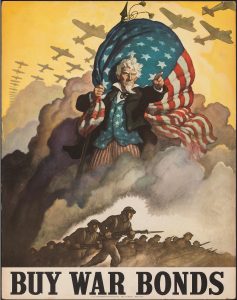
War is expensive. The United State States spent more than $300 billion biding the access powers and supplying our allies, and that was back in the forties. That equals more than $4 trillion. Today, the United States Treasury offered Americans a series of war bonds. They could purchase during the war. You could purchase a $25 war bond for $18 and 75 cents, and the government would take that money to help pay for tanks, planes, ships, uniforms, weapons, medicine, food, and everything else that the military [00:25:00] needed to fight and win 10 years after you purchased your war bond.
You could turn it in and get $25 a whopping $6 and what was it? 75 cents. 25 cents. Yeah. That you earned. In 10 years, Americans were encouraged to help support the war effort by purchasing war bonds, posters, picturing Uncle Sam or a soldier on the battlefield, implored people to do their part. Celebrities traveled the country putting on live shows.
They did radio programs promoting war bond sales and children got involved as well. Purchasing 25 cent war stamps to paste into war bond booklets next.[00:26:00]
That’s it. This is right.
Yeah, this is right. Yep. This is right because this is about, these next few are about buying bonds. Okay. This poster was published in 1942 and depicts a smiling pilot in his cockpit with numerous airplanes flying behind him. You buy ’em and will. The poster was designed to create a positive outlook on the war and to give people at home confidence that the work they were doing was having an impact.
The artist, this was a father and son artist team Jay Walter Wilkinson and his son Walter G. Wilkinson, and they created a series of six warban posters to create to, to motivate Americans. To finance the [00:27:00] war effort. If you are familiar with Honor Flight, this poster is one that was selected, um, as one of their informational, uh, postcards a few years ago.
Next, my very favorite, who can resist this little face, the fourth, fifth, and sixth war loan. Drives of 1944, raised nearly $59 billion. The Sixth War loan. The sixth War loan drive netted a record breaking $21.5 billion of that 59. This poster with the baby girl pinup and other official Treasury department posters.
Printed in quantities of 100,000 or more to encourage the [00:28:00] sale of bonds Next, and we go from the sublime to the, oh my goodness. Here we go. With James Montgomery flag again, using himself once again as the model for Uncle Sam. This one was obviously produced after the Nazi defeat. With the US turning all of its energy to the Pacific Theater, uncle Sam was rolling up his sleeves, ready to continue the fight for the next challenge.
We couldn’t rest on our laurels. We had won a stunning victory in Europe, but we still had to win the victory in the Pacific Theater. Sam didn’t just want you, he wanted your money to help pay for the war effort.[00:29:00]
Next,
this one is one of the first ones, uh, that was published just like the December 7th one. Um, when you have to create a poster on the fly and get it out there really quick. Sometimes the simplest message is the best. Just a flag and give it your best. And that’s what this one was. This was a appeal to American patriotism and it apparently it worked.
Next, this is the only poster or one of the few, most of the posters are, are rah, rah, other things. But this is one of the very few posters which visually associates. Fight for freedom in World War II to the fight for freedom in the Revolutionary War. Um, the artist was Bernard Lin and [00:30:00] he was part of that art students league, where apparently a bunch of them were communists, but he created murals for post offices before the war.
In fact, if you come to Fort Thomas and go to our post office. You won’t see his mural, but you will see one of those WA WPA posters or murals on the post office. Next.
During World War ii, racial restriction and segregation were facts of life in the US military, an overwhelming number. Of African Americans, actually majority of African Americans participated wholeheartedly in the fight against the axis powers with an eye toward ending racial discrimination at home.
They were gonna defeat discrimination in the service and then come back and defeated at home. [00:31:00] The government was well aware of the demoralizing effects of racial prejudice and its impact on the war effort. Consequently, it created a series of posters, pamphlets, and films highlighting the participation and achievement of African Americans in military and civilian life.
The artist was Alexander Lieberman, who was born in Russia. He and his family moved to London and then to Paris, and in 1940 the Lieberman family pulled a Casablanca. And escaped to the unoccupied zone in France, then to Spain, and eventually to New York.
The next one, in the face of acute wartime labor shortages, women were needed in the defense industries, the civilian service, and even the armed forces. More than 6 [00:32:00] million women took wartime jobs in factories. 3 million volunteered with the American Red Cross and over 200,000 served in the military.
Women were restricted from combat zones, however many of them became nurses to help the men injured in combat. I’ve just got a couple of women posters here. There are war and some of these posters can fit in multiple categories, but this one. I particularly liked because it was about mail call. This was designed, we didn’t have email and they didn’t call home.
We didn’t have video chats. What they needed was mail call.
This particular poster was designed to encourage letters. To boost morale for the troops [00:33:00] overseas and hopefully it work.
The last poster I’m gonna talk about next, yep.
Nurses were really super unsung heroes in World War ii, and this particular poster was, you know, become a. They were recruiting for nurses, but this story just is so charming. 17-year-old pre-med freshman, Wesley Wooten was earning her tuition as a model for Fifth Avenue fashion shows for the Walter Thompson advertising agency when she was called to do a shoot for this recruiting ad for nurses in June of 1942.
You need to understand the poster was done. We had the cap. We had the sleeves and the arms. We [00:34:00] had the become a nurse. All they needed was a face. They called her in to do the job, got her face. We’ve got the poster. After the war, she married Royal New Zealand Air Force Pilot, Noel Ney, and became a popular fashion and advertising model.
She never saw the poster until well after the war. She and her family were visiting the United States from New Zealand and they went to the Smithsonian, one of the Smithsonian museums that was exhibiting posters and there’s was hers hanging. And one of her children goes, mom, that’s you. And that was the first time she had seen it.
This is just a sample of the posters in our collection. A few years ago we had an exhibit and we [00:35:00] selected about 75 of, of the 267 posters, about half from World War I, half from World War ii. This is about half the World War II posters. Um, they’re not always all out. Some of them are not as pretty as some of these, sometimes they’re.
This big, we have posters that are bigger than I am. We have posters from foreign countries, um, and we try to keep, we try to rotate some in and out. Ours came to us already mount mounted on Masonite, and they were rescued by one of our volunteers. Our posters actually came to us from the DAVI respect the DAV.
They were ready to throw them away. They were gonna put them in the dumpster and Jim Cheney said, don’t do that. I know somebody who can use them. And that’s how we acquired them. We keep them in climate controlled [00:36:00] storage and we try to keep at least a few on display at all times. I thank you for inviting me to share just a little bit about the Art of War.
I think I’ve got a few more minutes if you have questions. I might be able to answer. Um, I’m not gonna swear to that. It depends on what you, depends on what you ask me. The museum is in Fort Thomas. If you, I like to tell a little joke and I hope you don’t get offended when you live in Kentucky and you wanna cross the Ohio River, it’s this wide and it takes us two minutes to get across the river.
For those folks in Ohio who don’t live near the river, the river is this wide and it takes days to get there. The museum is located in Tower Park at Fort Thomas, um, and [00:37:00] um, the museum is in the original. Administrator’s office for the original hospital, not the VA hospital that we have there. Now, that VA hospital was a Barx in 1939.
[email protected] and even though we will be closing to the general public in a couple of weeks. We can arrange for private tours up till about the middle of December. I just need about 24 to 48 hours notice.
Um, and then we will open again to the public the first weekend in April. So are there any questions?
Speaker 4: there? There’s really, [00:38:00] this really isn’t a question, just a comment. Okay. You had a picture of. The person repairing the pants with the uh,
Speaker 5: yes.
Speaker 4: Uh, and I, I grew up on a farm and, uh, even in the fifties when I remember things, they had the people that supplied the, the PE feed, especially supplements for animals, put the sacks, made the sacks of cloth that you could make clothes out of.
So that was their advantage to selling. If, if you could sell a, a feed with the, the cloth to make clothes, yes, it’s better than the companies that didn’t. And that was because there was a real shortage of cloth during, uh, world War ii.
Speaker 2: Yes. Well, that started even in the depression. Uh, the, the late in the mid to late 1930s, they started putting, because mothers [00:39:00] were making the dresses.
And shirts for their children out of the feed, feed sacks, and some marketing manager who hopefully got some sort of prize for it, said, how about we put patterns on those, you know, floral or whatever. So, yeah, that, that happened. You had a question, ma’am. You need to. Yeah,
a question or a comment.
Speaker 6: I was just going to ask you, since this exhibit is I guess gonna be put away for a while, most of it, um, do you know yet what other exhibits you might have in spring?
Speaker 2: We will continue to have, uh, I have two rooms dedicated to military. All the time. It just changes. The exhibits are just in there right now.
If you come this year, [00:40:00] uh, we’re still, um, honoring the 250,000, uh, soldiers and airmen who process through there next season. The three big display cases in that room will, each case will be dedicated to. A particular soldier and I’ll have uniform and tell the story and that kind of thing from different time periods.
Um, the other room, we have veterans because we’ve got the VA hospital right there. We have veterans who come down and the upstairs room is going to swap out and no longer be fully a medic room. ’cause we were, we were very thankful for all the medical personnel. Um. I’m gonna put some things in there that those, these, these folks that come down and visit us every month are fascinated with, and I’m gonna make sure that I have some of those [00:41:00] things there for them.
Um, I have posters that have all of the unit badges and patches from World War ii, from the Army, the Army Air Corps, the Navy, and the Marines. So they like to come and see if their patch is on there.
Pardon me? What?
Speaker 2: Okay. She’s got a follow up.
Speaker 6: Yeah. Just quickly, um, is your museum then basically based on like military interest or there It’s
Speaker 2: about two thirds military and about one third community because two rooms that are currently military are going to become, one, room’s gonna become about the schools.
One is going to be decades of businesses from probably 1900. You know, that kind of thing. There’s a question right here. Okay. When did they stop processing the last soldier? Processed through there in [00:42:00] April of 1964. Okay.
Speaker 5: That’s all.
Speaker 2: Mm-hmm.
Speaker 3: Uh, do you have anything on the three Cs, which some people say that’s why World War II was won
Speaker 2: the Civilian Conservation Corps.
Speaker 3: Correct.
Speaker 2: Before that, we had the citizen military training camps in the twenties we had, following World War I. This is in the days before Razi and all of that kind of thing.
There was a patriotic fervor and the army came up with the idea of the citizen civilian military training camps for young men between the ages of, say, 18 and 20 or 18 to 22, and they would come for a month and do training. If they [00:43:00] completed four summers, four months, uh, over the course of four years, uh, they could be commissioned a second lieutenant if they wanted to.
And a lot of those young men formed the cadre of junior officers when World War II began. Civilian Conservation Corps started in the thirties, and that was a result of programs. Trying to help young men support their families, help support their families. Um, but we had both of those at Fort Thomas. I’ve got pictures.
Yeah.
Speaker 3: And I’ll have to do some checking, but it’s a possibility that I’m the third generation. That process through Fort Thomas,
Speaker 2: that’s quite likely our first, our first soldiers were there in 1890. Yes, sir.
Speaker 5: Yes, I’m Todd. [00:44:00] And, uh, on Monday we had a, a Halloween costume, uh, square dance, and I immediately recognized one of my fellow dancers as Rosie the Riveter from the Rosie the Riveter Yes.
Poster.
Speaker 2: Yeah. We don’t, we do not own a Rosie the Riveter poster. Uh, original, um, I had a, a reproduction for a while on paper. Having posters mounted on Masonite is a blessing and a curse. Okay. Having just a paper poster, they are easily bent, torn, that kind of thing, mounted on Masonite. They still can have some damage, but they’re not, they’re, these are actually most of ’em in pretty good shape and, uh, but they just, they’re very heavy.
If there’s some that I can’t carry by myself. Other questions, [00:45:00] comments?
Speaker 2: Thank you.